
From the Archives
The Flores Incident of 1839:
Texas Rangers, Mexico, and the Cherokee
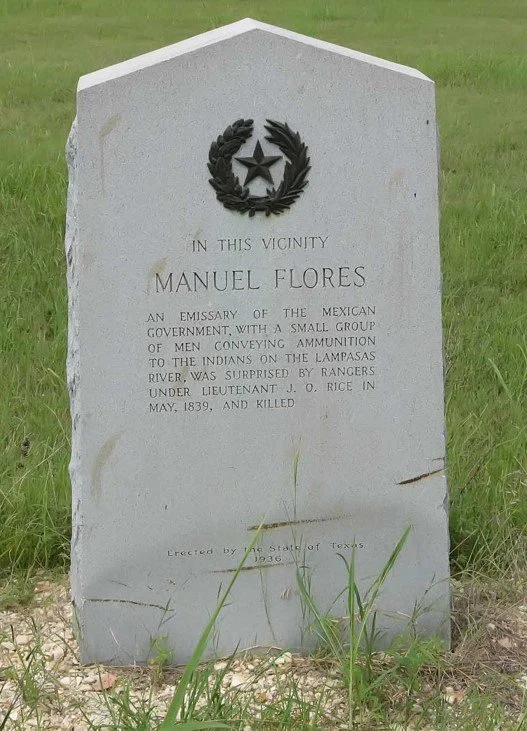
Located on northbound US highway 183 between Smokey Mo’s and Seward Junction.
This Texas Centennial Marker commemorates the site where Texas Rangers intercepted a party led by a Mexican government emissary involved in an effort to challenge the Republic of Texas. The incident was part of a larger conflict involving Mexico, the Cherokee, and the newly independent republic. Mexico hoped to regain control of Texas, while the Cherokee sought legal title to lands they occupied near Nacogdoches in East Texas.
The Córdova Rebellion
In the late summer of 1838, citizens of Nacogdoches uncovered a plot that became known as the Córdova Rebellion. Before Texas gained independence, the Nacogdoches region was home to a diverse population that included Tejanos and Native Americans, including Cherokee who had migrated into East Texas. Following independence in 1836, increasing numbers of Anglo-American settlers moved into the region, creating tensions over land ownership and political control.
During the Texas Revolution, Sam Houston had negotiated an agreement with Cherokee leaders, including Principal Chief Bowl. In exchange for remaining neutral during the revolution, the Cherokee were promised title to lands between the Angelina and Sabine Rivers, northwest of the Old San Antonio Road.
However, after Texas gained independence, the Texas Senate refused to ratify the treaty. With their land claims unresolved, some Cherokee leaders sought other means of securing their territory, including an alliance with the Mexican government.
The Flores Incident
On May 15, 1839, a company of Texas Rangers led by Lieutenant James O. Rice, a resident of Bagdad (now part of present day Leander), began tracking Manuel Flores, an emissary of the Mexican government, and a small group of men.
Two days later, the Rangers intercepted Flores and his party near the banks of the North San Gabriel River. Fighting broke out, resulting in Flores's death. The surviving members of his party fled, leaving behind horses, mules, and personal belongings.
Among the items recovered were letters encouraging Native Americans to take up arms against the Texians, along with correspondence addressed to Vicente Córdova and Chief Bowl. These documents provided evidence of Mexican efforts to encourage resistance against the Republic of Texas.
The Aftermath
Although Sam Houston believed Chief Bowl's denial of involvement with the Mexican government, Mirabeau B. Lamar, who succeeded Houston as president in December 1838, took a different view.
The Flores Incident heightened suspicions of Cherokee involvement in efforts to undermine the republic. Combined with growing pressure from settlers seeking Cherokee lands, these tensions contributed to Lamar's decision to force the Cherokee from Texas in 1839.
Today, the Texas Centennial Marker commemorates this conflict and its connection to the larger struggle over land, sovereignty, and political power during the early years of the Republic of Texas.
Sources:
William L. Mann, “San Gabriels, Battle of the,” Handbook of Texas Online, accessed December 11, 2020, https://www.tshaonline.org/handbook/entries/san-gabriels-battle-of-the.
Anonymous, “Cherokee War,” Handbook of Texas Online, accessed December 11, 2020, https://www.tshaonline.org/handbook/entries/cherokee-war.
Rebecca J. Herring, “Córdova Rebellion,” Handbook of Texas Online, accessed December 11, 2020, https://www.tshaonline.org/handbook/entries/cordova-rebellion.
Dianna Everett, “Bowl,” Handbook of Texas Online, accessed December 11, 2020, https://www.tshaonline.org/handbook/entries/bowl.
Introducing Signs of the Times:
Exploring the History Behind Leander's Street Names
We travel them every day, often without giving their names a second thought. But have you ever wondered how Leander's streets got their names? Who were the people behind them? What places, events, or pieces of local history do they commemorate?
Street names are more than just a way to get from one place to another. They offer glimpses into our community's past, preserving the names of early settlers, forgotten landmarks, historic communities, and the people who helped shape the place we call home.
In Signs of the Times, the Mason Heritage Foundation explores the history hiding in plain sight—one street sign at a time.
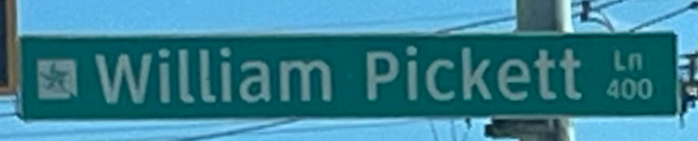
For our first installment of Signs of the Times, we're exploring the life of William M. “Bill” Pickett, a pioneering Black cowboy and rodeo performer whose roots trace back to what is now Leander. His remarkable story is commemorated by William Pickett Lane. The street sign can be found where it intersects Hero Way near the new Home Depot, and serves as a reminder of Leander's connection to one of the most celebrated cowboys in American and rodeo history.
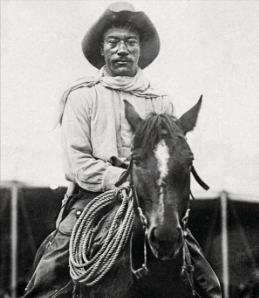
Pickett was billed as “The Dusky Demon,” a nickname some historians suggest may have been used to obscure his African American heritage at a time when Black cowboys were barred from certain rodeo competitions.
William M. “Bill” Pickett was born on December 5, 1870 or 1871, in what is now Leander, Texas. As a young boy, he admired his older cousins, who had worked as cowboys on the now famous Chisholm Trail. Inspired by their experiences, Pickett worked to develop his own cowboy skills and eventually became famous for inventing bulldogging, a technique for bringing cattle to the ground that developed into the modern rodeo event of steer wrestling.
After working on several area ranches, Bill and his brothers started the Pickett Brothers Bronco Busters and Rough Riders Association in the 1890s in their new home of Taylor. In 1905, Pickett was recruited by the Miller brothers of Oklahoma to join their 101 Ranch Real Wild West Show. As one of the show's featured performers, he demonstrated his famous bulldogging technique to audiences throughout the United States, Mexico, South America, and England. He continued performing and working for the 101 Ranch for many years.
Pickett and his wife, Maggie (Turner) Pickett, raised two daughters and made their home in Oklahoma. During the Great Depression, Pickett was still working at the 101 Ranch, breaking horses for sale, when he suffered severe injuries in an accident. He never recovered and died on April 2, 1932. He was buried in a pasture on the 101 Ranch.
Beyond his accomplishments in the rodeo arena, Pickett appeared in several early Western films. His contributions to rodeo and Western history earned him numerous posthumous honors, including induction into the National Rodeo Cowboy Hall of Fame in 1979 and the ProRodeo Hall of Fame in 1989. In 1994, he was commemorated on a U.S. postage stamp. His legacy has also been celebrated through portrayals in the films They Die by Dawn (2013) and Netflix's The Harder They Fall (2021).
From his beginnings in what is now Leander to his international fame as a Wild West performer, Bill Pickett became one of the most influential Black cowboys in American history.
Signs of the Times is an ongoing local history series presented by the Mason Heritage Foundation, with a link to the other articles. That will help turn individual blog posts into a connected series.
A New School, A Familiar Name
Back to school brought the opening of a new Leander ISD campus at the corner of Halsey Road and San Gabriel Parkway. The Ada Mae Faubion School for Early Childhood welcomed its first cohort of three- and four-year-old students this fall.
For those who have lived in Leander for any length of time, the name Faubion is a familiar one. The Faubion family arrived in the Leander area in the 1850s, and their roots remain firmly planted in the community today. The name is also familiar to generations of Leander students through Faubion Elementary, which closed its doors for the final time at the end of the 2025–2026 school year after educating Leander children for fifty years.
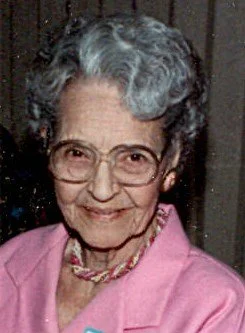
Both schools carry the name of Ada Mae Faubion, a beloved Leander educator who taught third grade from 1935 until her retirement in 1974.
There’s also a fascinating connection between the new school and the Faubion family’s history. The early childhood campus sits on what was once part of the family’s property, originally known as Oak Grove Farm. Less than half a mile from the historic Faubion farmstead, the campus occupies land where the family once grew hay for their cattle and planted corn.
More than 170 years after the Faubions first arrived in the Leander community, a new generation of Leander children is beginning its education on land that was once part of their farm.
It’s a wonderful reminder that even as Leander grows and changes, its history remains woven into the places where we live, work, and learn.